


STEM for Equity: Youth Perspectives on Community, Environment, and Justice

Reflections by Selena Jagdeo and Dania Sherif:
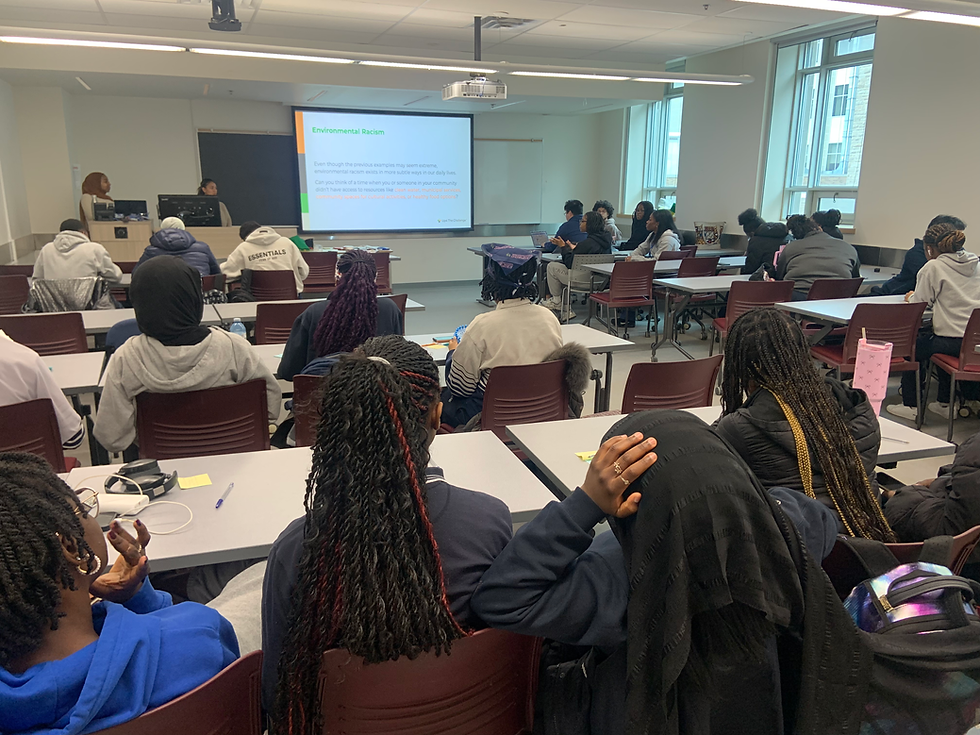
In April, we co-facilitated the STEM Design Experience workshop in collaboration with McMaster University’s MePLUS Program. The workshop invited high school students to reflect on critical social and environmental challenges while encouraging them to think deeply about the systems that shape their communities. These topics are essential to understanding broader societal and structural determinants of health.
For many students, the conversations went beyond theory. They reflected not only on their own lives but also on the experiences of their families and communities. This perspective allowed them to recognize how environmental racism operates across generations and geographic spaces, shaping opportunities and vulnerabilities.
Through hands-on design activities, students explored how fields like engineering, biochemistry, and environmental science intersect with social justice. By examining how infrastructure, technology, and resource distribution shape community well-being, they began to see STEM as a powerful means to address inequities rather than merely a technical pursuit.
By integrating STEM design principles, the workshop enabled students to transform their insights into practical solutions. For example, one student reflected that many challenges could be prevented if people who truly represent community values were better integrated into school systems. They extended this idea further by suggesting that the same principle should apply to decision-makers in positions of power, such as engineers, planners, and policymakers, particularly in shaping housing laws and infrastructure development, so that diverse voices and lived experiences directly inform how neighborhoods are built and sustained. Insights like these showcased not only the students’ capacity for critical thinking but also their ability to connect local concerns to larger structural issues.
As facilitators, the experience was equally meaningful. It reminded us of the privileges we often take for granted, such as reliable housing, food security, and access to education. Witnessing students approach these difficult conversations with openness and maturity was inspiring. Despite the sensitivity of the topics, they were willing to connect their own neighbourhoods and lived experiences to broader systemic issues, demonstrating an incredible capacity for awareness, empathy, and advocacy.
Moving forward, we hope to see more opportunities that empower youth to reflect, question, and design meaningful responses to inequities in their communities. The workshop not only sparked critical thinking but also highlighted the potential of students to use STEM as a framework to address pressing challenges, from reimagining healthy, sustainable food and housing systems to improving access to clean water and green spaces. They are not just future leaders—they are already changemakers in the present.


Comments