


Community Engaged Learning: NEW Experiences

Updated: Apr 30
Reflections from Tina Do and Grace Armstrong
From September to March, we had our student placement with Up4 The Challenge through the University of Toronto’s New College Community Engaged Learning (CEL) program. Over the course of the Fall and Winter terms, we worked roughly 5-7 hours per week with a team focused on youth engagement, social justice, and community-based STEM (science, technology, engineering, and math) education across Toronto and the GTA. What began as a slightly uncertain commitment quickly became one of the most formative experiences of our academic year.
The CEL program is a placement based course designed to connect students with non-profit and community organizations, with an emphasis on social justice movements, transformative change, and creative models of community-engagement. Rather than focusing only on classroom-based learning, it asks students to engage with real communities and real challenges to build professional skills through supporting programming of community partners. Through this placement, we were involved in the research, development, and facilitation of four workshops aimed at encouraging youth to think critically about topics related to the environment, health, and justice.

At the outset, we were both unsure of what we were bringing into the space. Although we are both STEM students, our academic backgrounds are quite different (Grace is a 3rd year student that studies Forest Conservation and Environmental Science, while Tina is a 4th year student that studies Health & Disease and Immunology). While there are broad connections between these fields and the themes of the workshops, they did not always feel immediately relevant. We found ourselves questioning whether our academic training was applicable, and more importantly, whether we had the credibility to be leading discussions on topics we were still in the process of learning ourselves.
This uncertainty was compounded by the nature of the work. Much of what we were asked to do fell outside of our previous experience. Neither of us had very extensive experience in human-centred design, creating STEM-based workshops for youth, facilitating discussions with large groups, or conducting open-ended self directed research. In many of our courses, the expectations are well-defined: you are given a question, a set of readings, and a framework to guide your thinking. This experience was different. We were often starting from scratch and figuring out what information was important, how to structure it, and how to present it in a way that would resonate with a younger audience.
One of the biggest challenges we encountered was translating complex and nuanced concepts into something accessible. Many of the topics we explored (whether environmental issues, biases in Artificial Intelligence, or broader questions of STEM justice) do not have simple explanations. They are layered, interdisciplinary, and often difficult even at the university level. This raised a series of ongoing questions for us: how much background information is necessary for students to engage meaningfully? At what point does simplification become oversimplification? How do you encourage students to challenge themselves without making it too difficult that they may feel discouraged? And how do you maintain the integrity of a topic while still making it engaging and understandable?
Closely tied to this was the process of developing “How Might We” questions, which became a central component of the workshops. These questions are designed to prompt discussion and encourage creative problem-solving, but crafting them is more difficult than it initially seems. They needed to be specific enough to feel grounded in real issues, but open-ended enough to allow for a range of responses. If they were too complex, students might disengage. If they were too simple, the conversation risked becoming superficial. Finding that balance required us to think carefully about the students themselves and what they might already know, what they might find interesting, and how they might approach the problem.

Alongside these conceptual challenges were more practical concerns. Presenting in front of groups of students was initially intimidating, especially given our own uncertainties about the material. There was a sense that, as facilitators, we were expected to have answers to all questions and to be able to guide discussions confidently, while responding to questions with authority. Early on, this expectation felt difficult to meet. We were still learning the material ourselves, refining our understanding, and still figuring out how to communicate effectively in this setting. We were also learning how to work in a team and how to divide the work evenly amongst ourselves, but still informing each other of what we were learning.
However, as the weeks went on and we facilitated more workshops, our perspectives began to shift. We started to realize that the role we were stepping into was not about being an expert in the traditional sense. The workshops were not lectures, and we were not there to deliver perfectly polished information. Instead, our role was to create a space where students felt comfortable engaging, asking questions, and sharing their own ideas. Our aim was to create a space where any question and every answer was one that contributed to moving all of our understanding further.
This shift was subtle but significant. Rather than focusing on whether we had the “right” answers, we began to focus on how we were interacting with students. Were we listening to them? Were we encouraging participation? Were we responding thoughtfully to their ideas? As we became more comfortable in this role, our initial concerns about credibility began to fade. What mattered more was not the depth of our expertise, but our ability to facilitate meaningful conversations and make students feel comfortable and engaged with the material. We wanted those participating to feel excited, and understand the passion that can come from STEM innovation.
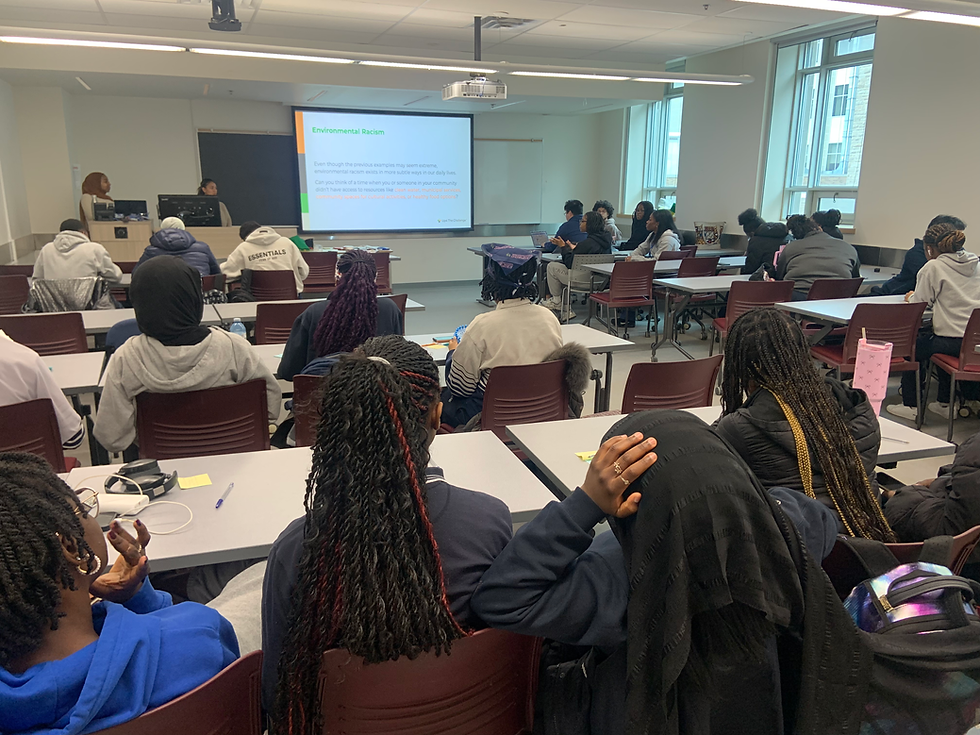
This year, we were able to facilitate a diversity of different types of workshops, including two workshops with Women in Science and Engineering (WISE) UofT, an online workshop for National Engineering Month, and one at a high school in the Toronto area. All of these required us to work with different groups of students that ranged in age, gender, and interests. This forced us to take different approaches at each workshop to efficiently cater to the interest of each group and appropriately address the learning levels of everyone. One thing stuck with both of us: how great it was to see the passion for STEM coming from such a diverse background of students and how it felt to encourage students to engage in STEM.
Through this process, we developed a range of skills that extend beyond the classroom. Our confidence in public speaking and presentation improved significantly, not because we became perfect presenters, but because we became more adaptable. We learned how to adjust in real time: how to respond when a discussion took an unexpected turn, or when an activity did not go as planned. We also became more comfortable with uncertainty, recognizing that not every question needs an immediate or definitive answer.

Equally important was the opportunity to be part of a supportive and collaborative team through Up4 The Challenge. We frequently bounced ideas off each other, critiqued our work, and went to each other when the work may have been difficult or overwhelming. The importance of communication and efficiency became very clear to us by the end of our placement. Working with others who were similarly committed to community engagement and social justice created an environment where we could learn from each other, share ideas, and reflect on our experiences. It also opened up opportunities to connect with people working in fields that we had not previously considered, broadening our understanding of how our own academic interests might intersect with community-based work.
Looking back, the concerns we had at the beginning of the internship (about relevance, expertise, and credibility) feel much less significant. While those questions were valid at the time, they became less important as we gained experience and perspective. What stayed with us instead was a deeper understanding of what makes these kinds of spaces meaningful.
The most impactful moments were not the ones where we delivered information perfectly, but the ones where students felt engaged and where they asked thoughtful questions, shared their perspectives, or built on each other’s ideas. Those moments depended less on our ability to provide answers and more on our ability to create an environment where students felt heard and respected.
This experience reinforced the idea that education, particularly in community-based settings, is not simply about transferring knowledge. It is about fostering dialogue, encouraging critical thinking, and building connections. It requires a willingness to listen, to adapt, and to approach conversations with openness rather than authority. As university students, much of our learning occurs in the classroom. However, by having a placement at Up4 The Challenge, we were able to develop and practice skills in a real-world setting, and apply concepts that we were taught in the classroom to what the work we were developing.
If there is one thing we will take away from our time with Up4 The Challenge, it is this: showing up with care and intention matters. When students can see that you are genuinely invested, that you are listening to them and valuing their input, they respond in kind. In the end, that connection is far more important than having all the answers.


Comments